
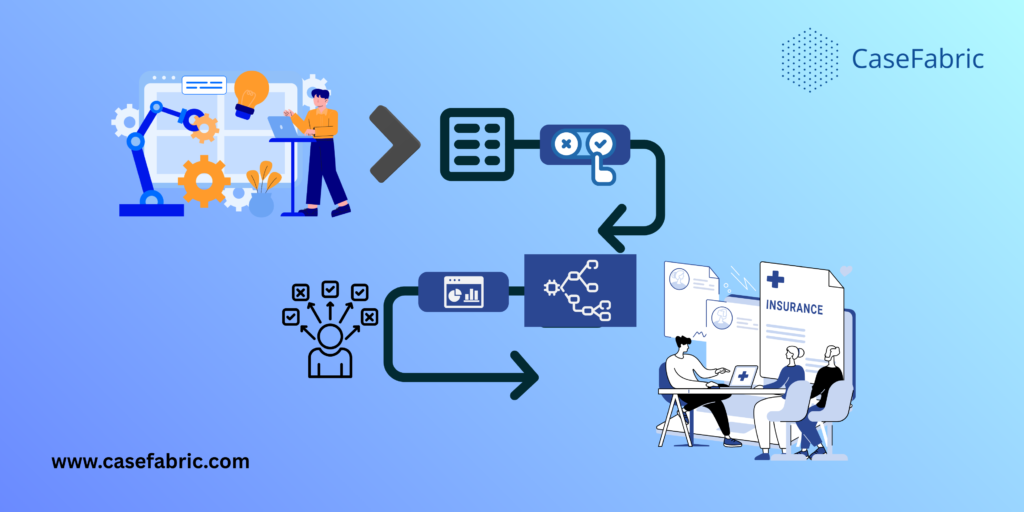
Case Management in dynamic workflows fundamentally differs from traditional ones. Rather than following predetermined paths, it evolves based on context and real-time decisions – requiring intelligent orchestration, not rigid automation.
Orchestration is best understood with a simple analogy. Think of enterprise IT like a symphony orchestra. Without a conductor coordinating the timing and handoffs, even skilled musicians produce noise rather than harmony. The orchestration engine serves as this conductor, synchronizing departments, systems, and processes.
Orchestration transforms case management from rigid, linear workflows into flexible, adaptive, enterprise-wide orchestration — ideal for modern business complexity.
Orchestration provides two critical capabilities:
Contextual Adaptability: Enterprise processes often involve unstructured workflows where next steps only become clear during execution. The orchestration engine enables runtime adaptation based on context, unlike rigid process tools that lock you into predefined sequences.
Holistic Integration: Modern enterprises operate with disparate systems across departments, each with unique workflows and data structures. The orchestration engine connects these silos, transferring data securely between them and enabling the departments and applications to interact while executing a case. Moreover, it adheres to rules of compliance and access-control. The engine connects the applications into a holistic platform, eliminating brittle point-to-point integrations that become unmanageable at scale.
Orchestration moves case management from rigid control to intelligent collaboration—from predetermined processes to adaptive workflows that respond to context. Whether managing claims, compliance processes, or complex enterprise workflows, the orchestration engine ensures seamless coordination between human workers, automated systems, and AI agents.
Orchestration in Action: Claims Management in Dynamic Case Management Solutions
To understand the practical power of an Orchestration Engine in dynamic case management solutions, consider how it transforms claims management – a domain characterized by complexity, subjectivity, variability, and the need for rapid decision-making.
Traditional claims management systems often struggle with rigid workflows that can’t accommodate the nuanced reality of different claim types or the different paths a claim process can take. A simple auto insurance claim follows a different path than a complex commercial property claim or a medical malpractice case. Each requires different information, involves different stakeholders, and demands different decision points.
Dynamic Case Progression: With an orchestration engine, a claims solution adapts to each unique situation. When a new claim arrives, the orchestration layer evaluates the context, claim type, severity, policy details, regulatory requirements, and dynamically determines the appropriate workflow. If new information emerges mid-process (perhaps fraud indicators or the need for expert assessment), the orchestration engine seamlessly adjusts the case path without requiring process redesign or system reconfiguration.
Cross-Departmental Coordination: Claims processing touches multiple areas: customer service receives the initial report, adjusters assess damage, legal reviews liability, finance handles payments, and compliance ensures regulatory adherence. The orchestration engine coordinates these handoffs automatically, routing information to the right people at the right time while maintaining a complete audit trail. When an adjuster needs policy documentation from the underwriting system or payment history from finance, the orchestration layer retrieves this data in real-time from connected systems.
Automated Decision Support: A low-code development platform allows business users to configure decision rules and automation triggers without deep technical expertise. An orchestration engine executes these rules intelligently, automatically approving straightforward claims under certain thresholds, escalating complex cases to senior adjusters, triggering investigations when patterns suggest fraud, or initiating legal review when liability questions arise.
Exception Handling and Escalation: In dynamic scenarios, exceptions are the norm rather than the outlier. A document might be missing, a third party might be unresponsive, or new regulations might require additional steps. An orchestration engine manages these exceptions gracefully, automatically escalating stalled cases, notifying relevant stakeholders, and ensuring nothing falls through the cracks.
Agentic AI support: AI agents can be a great support in effective decision making and underwriting. It has its challenges too. Especially when an agent can influence the way a claim is brought to solution. Orchestration can operate AI within the guardrails to assure security, privacy and auditability. AI agents when embedded the right way in your orchestration layer can improve operations without compromising on security.
A claims management solution built on a platform with an orchestration engine handles the full spectrum of cases, from routine to complex, with efficiency and consistency, while maintaining the flexibility to accommodate unique circumstances. The result is faster processing, satisfied customers, and better compliance – all enabled by intelligent orchestration.
The CaseFabric Orchestration Engine
Following the CMMN paradigm, the CaseFabric Platform leverages orchestration to synchronize case workers, agentic AI tools, and automated processes with real-time data access – delivering the scalability, flexibility, and security essential for true dynamic case management.
The CaseFabric Case Management platform has been specifically developed to build and execute CMMN-based Case Models; but its benefits surpass the initially intended outcomes. It allows enterprises to extend their IT Infra and incorporate newer technologies. The engine also makes the enterprise IT composable where capabilities can be combined, recombined, and extended as business needs evolve.
Orchestration matters not just in Dynamic Case Management, but in any organization seeking to gain operational efficiency, enhanced compliance, composability, superior experiences, and the agility to evolve with emerging technologies. Is your enterprise ready to take the next step? Do email your requirements to info@casefabric.com