
Today’s enterprises face growing complexity across systems, teams, and workflows. Traditional automation and rigid integrations fall short in addressing this challenge. Orchestration in Case Management brings real-time coordination by aligning people, processes, and technologies. Platforms like CaseFabric use orchestration to enable intelligent automation, adaptability, and secure data flow. Discover how orchestration transforms fragmented operations into a unified, composable enterprise.
Enterprise operations are growing increasingly complex due to changing technological, organizational, regulatory, and customer-driven processes. Most enterprises manage operations by automating and streamlining them with the help of software solutions and products. However, many of these solutions have overlapping functions.
Overlapping functions are often aligned through point-to-point integrations or by defining processes and sub-processes that span multiple products. These methods often use Business Process Management type of tooling and make the solutions rigid, complex, and unmanageable. Hence enterprises need to design and develop a dynamic system that replaces these hardwired integrations and solves any related issues.
A more reliable way of meeting the new challenges – automations, integrations, and introducing dynamism – is with Orchestration. This is especially relevant for dynamic case management, as it is by definition about unpredictability, act upon insight, and contextual decisions.
Imagine an enterprise with different departments, each with their own systems and processes. If employees don’t enjoy knowledge access and transfer and if the departments don’t communicate clearly or share responsibilities among themselves, they produce duplicate and patched up work. Some may try to correct this with organizing tasks and responsibilities. But, building rigid cubicles and task groups doesn’t solve the problem, it rather worsens it. The solution is in establishing transparency, sharing resources and responsibilities, and communicating clearly. That is what orchestration is all about. It brings clarity and structure to people and products by allowing communication and integration.
Enterprises can find a modern solution for scalability, unpredictability, and security, in a case management platform that integrates products, allows connections across IT infrastructure, and more importantly enables building solutions with a practically viable orchestration layer. Leveraging Orchestration capabilities of dynamic case management platforms like CaseFabric, enterprises can automate end-to-end processes and linkup several other automation tools. Let us understand why orchestration is important and how you can incorporate it through CaseFabric.
CaseFabric’s take on Orchestration – Two Important Functions
- Operations in many enterprises include steps within unstructured processes driven by critical decisions. The next step in the process and the decisions are evident only during the execution and is dependent on the context. Orchestration helps the connected IT infrastructure and the case management platform act according to the context and adapt to the runtime needs.
- Enterprise products and platforms need to be integrated to access data across multiple departments like HR, Legal, IT, Finance, etc, each with its own workflows. Orchestration enables integrations in a holistic platform, in this case, the CaseFabric Dynamic Case Management Platform. The platform helps enterprises build solutions that connect departments, facilitates interactions, while ensuring security and compliance. Even more exciting aspect is – The IT infrastructure can be extended using the platform to include modern tools like AI Agents.
A good platform for case management, like CaseFabric, solves the problem of fixed process from an orchestration perspective. This aspect can be explained with the analogy below.
Your IT should Work Harmoniously like a Symphony, not as Individual Pieces of Music
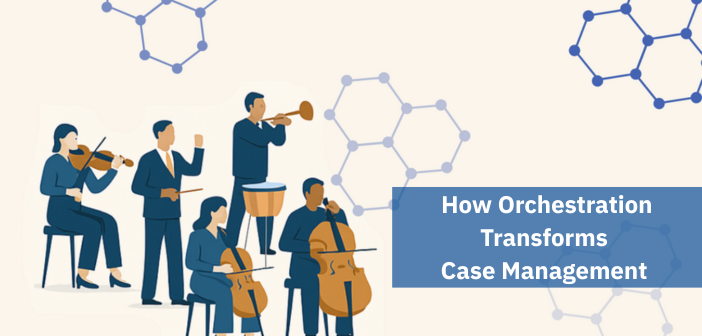
In a symphony orchestra, there are dozens of instruments, each with its own tone, rhythm, and role — strings, brass, percussion, woodwinds. On their own, they’re just individual contributors. But under the guidance of a conductor, all these parts come together in perfect synchronization to produce a cohesive musical experience.
In case management, orchestration works the same way.
- The instruments are your teams, departments, systems, data sources, and processes.
- The musicians are your case workers, customers, AI tools, and bots.
- The conductor is the orchestration engine — coordinating timing, sequence, handoffs, and escalation paths.
- In a symphony, if one section is off or comes in too early or too late, the conductor needs to act accordingly during the performance. The act cannot be a fixed pre-defined process.
- The CaseFabric platform works like an experienced conductor. When the solutions need to be dynamic, i.e. the process steps are decided upon at runtime, you need a specialized platform. Needless to say, a rigid process model doesn’t work in such a dynamic setup.
- Orchestration ensures everything — and everyone — is in sync and can access real-time updated data.
Orchestration Benefits Beyond Case Management
Orchestration is at the heart of a Dynamic Case Management solution, without which it cannot retain its dynamic nature. Orchestration enables scalability, flexibility, and security in a case management platform. An effective dynamic case management solution follows the Case Management Model and Notation (CMMN) paradigm and leverages an orchestration layer to integrate functional components. The benefits of orchestration, however, extend far beyond case management.
Orchestration is no longer a “nice to have” — it’s central not just to case management, but also to agility, scalability, compliance, and efficiency. It is a fundamental step in building a composable organization.
Orchestration: The Future of AI and Intelligent Automation
Case Management Platforms have an extended scope in the current AI landscape. The platforms have the potential to combine Business Process Automation and AI agents to analyse, predict, and automate parts of workflows. Integrating these advancements around an orchestration layer transforms platforms into intelligent, scalable, and adaptive ecosystems.
CaseFabric: Dynamic Case Management Platform with the Power of an Orchestration Engine
In an era where interoperability is paramount, organizations must rethink orchestration, by choosing a scalable dynamic case management platform. The advantages of orchestration extend much beyond case management. They help in making the entire IT infrastructure safer and easier to use.
CaseFabric places orchestration at its core, enabling:
- Seamless automation across silos, teams, and technologies
- Dynamic case progression and management of unstructured processes
- Secure and scalable integration of existing IT with the latest tech advancements like AI
CaseFabric enables seamless automation by integrating various siloes, teams, products, and technologies like, BPA, and AI. With CaseFabric, organizations unlock the full potential of both orchestration and dynamic case management, ensuring operational efficiency, enhanced compliance, and superior customer experiences. Curious about how CaseFabric can make your processes run more smoothly? Request a personal demo now!