
Whether you’re a fan of Bill Clinton or not, his catchphrase from the 1992 presidential election – “It’s the Economy, Stupid” – was brilliantly effective. Mostly because it was true: the economy makes the difference in people’s daily lives, and the economic outlook influences how they vote. Bill got elected.
The same principle applies to data. The way data is managed in enterprise software applications has a profound impact on business outcomes. This is especially relevant in Case Management solutions, which navigate many unpredictable paths before reaching resolution.
The Data Challenge in Case Management
Everyone would probably agree that data is a major driver in successfully closing cases. However, how data is used and how data management is implemented in software solutions is often poorly understood, leading to significant issues. Since data and processes are closely intertwined, solutions should be designed to consider both equally.
My years of building enterprise applications—from 4GL-based ERP systems like Baan to BPM-based low-code modelling platforms like Cordys—ultimately shaped how we built CaseFabric. Our Case Management platform integrates data and process into one holistic approach, finally aligning IT with Business when modelling software solutions.
What Matters Most: Process or Data?
Is it process that drives the data, or the other way around?
Short answer: In case management, it’s the data driving the process.
At the risk of sounding nostalgic, my long answer includes a bit of history.
The 4GL Era: Data-Centric but Unmanageable
When we built ERP applications using 4GL, everything centered around data and the data model. This doesn’t mean processes weren’t involved—ERP is fundamentally about processes: sales orders to process, purchase orders to fulfil, and so on. Some straightforward, some complex, some with case-like features.
Starting with the data model and implementing process support in code made everything flexible (exactly what you want for case management flows), but also extremely opaque and difficult to manage over time. The number of parameters needed to implement systems like SAP was staggering, and only a handful of people could maintain oversight.
The BPM Revolution: Process Takes the Lead
This complexity led to the emergence of Business Process Management (BPM), bringing process modeling into the spotlight. It provided a much better, graphical overview of actual processes—a significant step forward that many considered the holy grail.
But there were downsides. In some ways, putting process in the lead was actually a step backward.
First, not many processes are straightforward. Modelling complex, non-linear processes using sequential BPM models destroys the transparency everyone desperately sought. Worse still, process data often had to be handled outside the BPM model, creating new complexity: Maintaining process logic in both code and model and aligning data at both. Duplicating logic eventually always leads to high TCO.
CMMN: A Step in the Right Direction
To create a better fit with the complexities of non-linear processes the Case Management Model and Notation (CMMN) standard emerged. It was a significant advancement, especially for Case Management solutions.
CMMN is designed around the reality that processes are often not predefined. The decisions made along the way drive case flow and bring cases to closure. It uses event-driven and declarative thinking, combining Case Plans and Case Files as interactive parts of the model. CMMN actually models decision structures rather than process structures.
These are all positive developments, but let’s examine how CMMN works in practice.
It’s Still the Data (Really)
CMMN as a baseline modelling technique for Case Management has garnered negative feedback for two main reasons:
- Wrong Perspective: It’s often approached from a process modeling (or BPM) perspective. Unsurprisingly, it doesn’t live up to its promise when used this way.
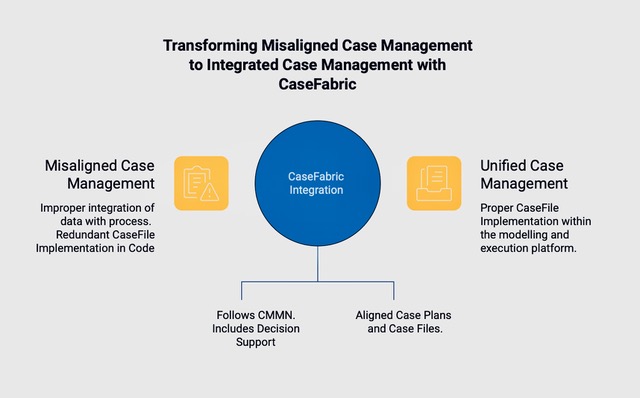
- Poor Implementation: Even when platforms use CMMN to model case management solutions, many lack one fundamental component—proper integration of data with process. In CMMN terms, they fail to properly implement the CaseFile.
Most platforms lack appropriate CaseFile implementations. CaseFiles are constructed in code, outside the model, yet must be kept aligned with it. This redundant CaseFile management in code leads to unnecessary complexity and issues similar to BPM implementations. It reduces case management platforms to mere model drawing canvases that cannot function as true Case Management execution engines.
The CaseFabric Solution
CaseFabric’s Case Management modelling and execution platform has integrated the CMMN CaseFile and CMMN CasePlan at its core. You can’t have the plan without the file. Everything in one place, with no alignment issues.
This integration enables you to build fundamentally better case management solutions that are:
- Future-proof: Built on solid architectural principles
- High-end: Delivering enterprise-grade performance
- Business-led: Empowering business users to model solutions directly
When it comes to case management, remember: it’s the data, folks. And how you manage it makes all the difference.
Ready to see how CaseFabric can transform your case management approach? Request a demo.