
Recent research confirms what forward-thinking organizations already know: AI adoption generates real business value when it’s integrated into workflows. Yet seamless integration remains elusive for most solutions.
The logical approach is to integrate AI through workflow and process automation platforms. But here’s the challenge: Today’s fast-evolving businesses need more than fixed process automation. They require decision support, non-sequential process handling, and the ability to adapt on the fly.
So, what helps businesses with AI adoption and generating value from AI is a way (a product, platform, or solution) to integrate AI into workflows while allowing businesses to change the workflows or processes as per their needs and context. Also, the right technologies can help them take the right decisions at various steps while executing processes. The help can come from AI when appropriate, or from the platforms or solutions. But humans should have the power to approve or change decisions to keep up the accountability of software systems.
In other words, modern enterprises need a platform that delivers all three: process automation, decision support, and, most critically, AI Agent Integration and Orchestration. This blog discusses the reasons behind ineffective AI adoption, best practices to integrate AI agents, and why a dynamic case management platform offering AI orchestration and integration will help businesses both with AI adoption and intelligent process management.
Why Enterprises Struggle with AI Adoption
Despite successful AI pilots and promising innovations, many enterprises remain cautious about AI adoption. The problem isn’t choosing the wrong models. It’s weak integration, missing context, and lack of traceability.
Organizations attempting to reduce technical debt with modern AI technologies often discover that isolated AI tools introduce new complexities or expose loopholes in their IT infrastructure. Only enterprises that have securely integrated AI into their workflows and established robust traceability mechanisms succeed in generating sustained value from AI.
As we move through 2026, enterprises are shifting their priorities. Rather than deploying isolated AI tools, they’re seeking integrable platforms with built-in AI capabilities, platforms that enable software development through integration and orchestration.
Best Practices for Integrating AI Agents
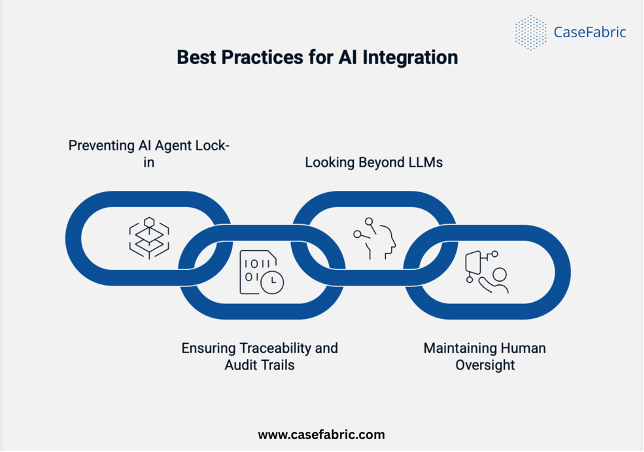
AI is evolving rapidly. Frequent upgrades are the norm, reliability isn’t guaranteed, and the technology’s trajectory remains unpredictable. Here’s how to future-proof AI integration:
Preventing AI Agent Lock-in
Technology integrations should remain functional even as AI agents change. Build flexibility into your architecture through standardized interfaces like REST APIs, message queues, event streams, so newer AI models can be integrated alongside or replace existing agents without disrupting workflows. This composable approach allows incremental adoption rather than disruptive replacements.
Ensuring Traceability and Audit Trails
Enterprise integration platforms must log which AI agents are active, what they’re doing, and when. Logs should capture every AI interaction with details of data accessed, analyses performed, recommendations generated, user context, and specific rules or models invoked. For regulated industries, this traceability is essential. Case workers must be able to trace any outcome back through the chain of automated and manual decisions.
Looking Beyond LLMs
AI isn’t just about large language models or Agents. Enterprises should leverage AI through integration frameworks that support any AI tool, from specialized analytics engines to document analysis, natural language processing for case routing, or predictive analytics for risk assessment. The platform should enable connecting diverse AI as well as human capabilities without overhauling the core infrastructure.
Maintaining Human Oversight
AI, as efficient as it might be, is still prone to errors and hallucinations. Verification checkpoints built into workflows support human review where it matters most. Parts of workflows can be handled completely by AI allowing human experts to focus on critical parts.
AI Integration with Dynamic Case Management Platforms
Dynamic Case Management requires building case context from multiple sources and leads the case steps across case workers, teams, and verticals. This requires integration and orchestration, i.e. IT Infra is connected and case tasks can be shared securely across knowledge workers (even if a specialized knowledge worker works outside the organization). The same integration when extended to AI Agent carries the strong foundation of the security and access control mechanisms that the dynamic case management solutions are built on. AI Agents must adhere to compliance and accessibility rules just like the case workers. Hence dynamic case management platforms with integration and orchestration abilities are uniquely positioned to support AI adoption.
Rather than executing isolated tasks, AI agents in dynamic case management platforms connect to multiple data sources to build cumulative understanding and automate or assist in wider workflows. The integration architecture allows AI agents to access past patterns, organizational precedents, and domain-specific knowledge while maintaining authorization rules and traceability mechanisms.
Consider an underwriting scenario: Through API integrations with credit bureaus, property valuation systems, and internal risk databases, an authenticated AI agent correlates information from separate silos. It analyzes historical underwriting decisions, identifies which property characteristics correlate with actual claim outcomes, and recognizes regional risk patterns by connecting geographic data with loss history. The integration layer ensures context from each data source remains safely accessible and contributes to progressively more informed assessments.
CaseFabric’s Approach: Transparent, Traceable, and Controlled
CaseFabric’s CaseRoom integrates AI agents directly into workflows, giving case managers and knowledge workers a unified, real-time view of both AI and human progress. Every agent action is logged with names and timestamps alongside human steps and is part of the same native audit trail that makes full decision traceability possible. Verification tasks can be inserted at any point so case workers or other agents can review and approve outputs before a case advances. Granular, role-based access control governs what each AI agent can see and do, applying the same authorization framework used for human workers, keeping security and compliance intact.
Is your enterprise ready for really leveraging AI Agents to their true potential and in a secure way?Explore how CaseFabric can prepare your organization for continuous AI adoption while preserving existing investments and operational knowledge.